Technology & Partners
Two technologies, one train.
HyBatch RO recovers the water. CEE Gen9 concentrates what is left, so only a small final residue needs disposal. Each stage is sold on its own or as a system.
The treatment train
Two stages that complement each other.
The concentrate from HyBatch RO feeds directly into CEE as one integrated system, called RealZLD. Water is recovered in the RO stage. CEE concentrates the remainder further, and only the final residue is disposed.
- Step 1 · Entry
Conditioned effluent
Filtration and adjustment beforehand.
- Step 2 · Membrane
Batch reverse osmosis
Recovers the bulk of the water at minimum energy.
HyBatch → reusable water - Step 3 · Handover
Concentrate
The minimum the membrane can no longer reduce.
- Step 4 · Thermal
Convection evaporation
Concentrates it further in a module, not in a pond.
CEE → minimal residue
Every product has its own value. Use HyBatch RO alone to lift recovery on an existing plant, or CEE alone for brines and concentrates. An optional sludge dryer is available as a final stage for sites that need a fully solid end product.
Stage 1 · Membrane · with Salinity Solutions
HyBatch: batch reverse osmosis
The reject is recirculated and concentrated inside a single batch. Pressure rises only when the concentration demands it, so the membrane never works harder than it has to.
- 30–55% less energy than conventional reverse osmosis.
- The circuit is flushed every cycle, so salts do not precipitate on the membrane.
- Lower pretreatment needs, and with them lower operating cost.
- Tolerates feed water of variable composition. Up to 98% recovery in specific cases.
Real metallurgical effluent: 90% recovery, from 12,119 one-minute records. Standard modules of 25 and 100 m³/day, with custom sizing.

Stage 2 · Thermal · with Quadsun
CEE Gen9: convection enhanced evaporation
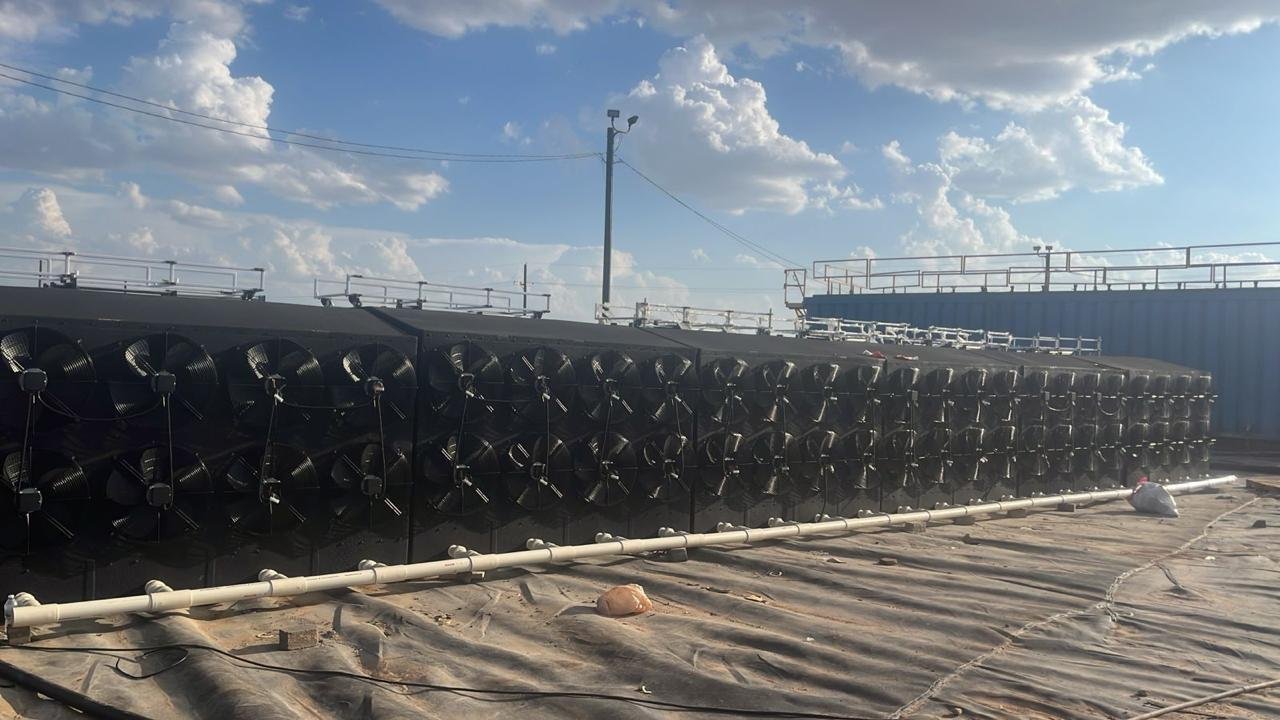
The evaporation pond, folded into a 9 m² module. It keeps the same free liquid surface, packs it in parallel and moves it with forced air. It concentrates what HyBatch RO leaves behind, at ambient temperature and pressure.
Natural evaporation pond
Large footprint, uncontrolled and dependent on the climate.
CEE module
Small footprint, fully controlled and independent of the climate.
Ambient temperature and pressure
No boiling and no steam.
Configurable modes
Concentration, or capture of salts.
No pretreatment
Up to 200,000 ppm.
Volatile stripper
Configurable in the same air stream.
Waste heat from 20 °C
Solar thermal or heat pump.
One row of modules replaces hectares of pond.
Capacity is adjusted by adding or removing evaporation surface, not by extending civil works. Modules can be added while the system is running.
Robustness
Built for effluents that destroy steel.
No corrosion by design
PP and PA6 trays, a fibre-reinforced casing and a titanium heat exchanger. Inert to chlorides, organics and aggressive pH, where steel fails.
Low, predictable running cost
No hot metal to scale and no conditioning chemistry. Fewer consumables, fewer stoppages, fewer hours.
Remote control, unattended operation
Setpoints for flow, temperature and relative humidity, with remote monitoring and an ESG record on every unit.
Comparison
Against how it is solved today.
| Parameter | Conventional RO + pond | MEE + ATFD | WWS: HyBatch + CEE |
|---|---|---|---|
| Water recovery | 70–80% | Partial | Up to 95%, 98% in specific cases |
| Operating energy | 14–25 kWh/m³ | 30–60 kWh/m³ | 5–9 kWh/m³ |
| Process steps | 2, plus external management | 2 | 1, from liquid to final residue |
| Pretreatment | Softeners and antiscalants | Required | Depends on application, with minimal conditioning compared with other RO |
| Footprint | Hectares of pond | Large, three evaporators | 9 m² per CEE module, RO in a standard container |
| Climate dependence | Total | None | None |
| Scaling up | Civil works | Difficult | Add modules while running |
| Investment | Client CapEx | High CapEx | Rate per m³ treated |
MEE: multi-effect evaporator. ATFD: agitated thin-film dryer. The WWS solution is the integrated HyBatch RO and CEE system.
Specifications
Side by side.
| HyBatch RO | CEE Gen9 | |
|---|---|---|
| Position in train | Stage 1: recovers the water | Stage 2: concentrates the remainder |
| Energy | 1.845 kWh/m³ measured, below 2 kWh/m³ | 20–35 kWh/m³ with waste heat Energy OpEx <€5/m³ |
| Recovery / concentration | Up to 95%, 98% in specific cases 90% on real metallurgical effluent | Reject concentration up to 95%, adjustable |
| Salt rejection | 97% | Not applicable |
| Feed | Variable composition, including high-conductivity effluent | Up to 200,000 ppm without pretreatment 350,000 ppm maximum TDS validated |
| Modules | 25 and 100 m³/day, custom sizing | 9 m², 0.5–5 m³/day each, scales in parallel |
| Construction | Metallic | PP and PA6 trays, FRP casing, titanium heat exchanger |
Recovery depends on the feed. Whole installations range from 25 to 1,000 m³/day.
Optional final stage
Sludge dryer
An optional final stage for sites that need a fully solid end product. Metallic construction.
Strategic partner
Seinec
Seinec is Wise Water Solutions’ strategic partner. They are not one of our technology suppliers. Their partnership gives WWS added financial credibility, so customers can commit to a project with confidence.
